




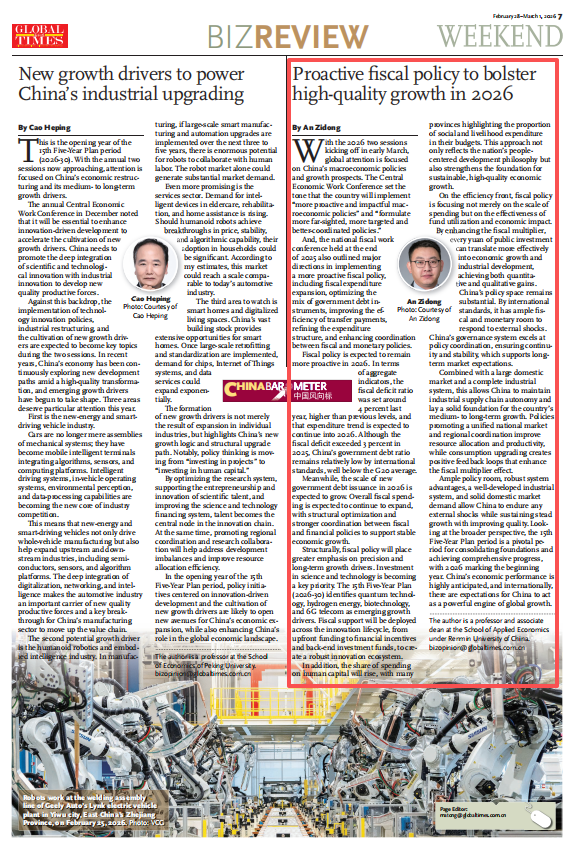
With the 2026 two sessions kicking off in early March, global attention is focused on China's macroeconomic policies and growth prospects. The Central Economic Work Conference in December set the tone that the country will implement "more proactive and impactful macroeconomic policies" and "formulate more far-sighted, more targeted and better-coordinated policies."And, the national fiscal work conference held at the end of 2025 also outlined major directions in implementing a more proactive fiscal policy, including fiscal expenditure expansion, optimizing the mix of government debt instruments, improving the efficiency of transfer payments, refining the expenditure structure, and enhancing coordination between fiscal and monetary policies.Fiscal policy is expected to remain more proactive in 2026. In terms of aggregate indicators, the fiscal deficit ratio was set around 4 percent last year, higher than previous levels, and that expenditure trend is expected to continue into 2026. Although the fiscal deficit exceeded 3 percent in 2025, China's government debt ratio remains relatively low by international standards, well below the G20 average.Meanwhile, the scale of new government debt issuance in 2026 is expected to grow. Overall fiscal spending is expected to continue to expand, with structural optimization and stronger coordination between fiscal and financial policies to support stable economic growth.Structurally, fiscal policy will place greater emphasis on precision and long-term growth drivers. Investment in science and technology is becoming a key priority. The 15th Five-Year Plan (2026-30) identifies quantum technology, hydrogen energy, biotechnology, and 6G telecom as emerging growth drivers. Fiscal support will be deployed across the innovation lifecycle, from upfront funding to financial incentives and back-end investment funds, to create a robust innovation ecosystem. In addition, the share of spending on human capital will rise, with many provinces highlighting the proportion of social and livelihood expenditure in their budgets. This approach not only reflects the nation's people-centered development philosophy but also strengthens the foundation for sustainable, high-quality economic growth.
On the efficiency front, fiscal policy is focusing not merely on the scale of spending but on the effectiveness of fund utilization and economic impact. By enhancing the fiscal multiplier, every yuan of public investment can translate more effectively into economic growth and industrial development, achieving both quantitative and qualitative gains. In the context of China's ongoing transition toward quality-focused development, efficiency-oriented fiscal policy will play a critical role in developing new growth drivers, advancing technological innovation, and building human capital.
China's policy space remains substantial. By international standards, it has ample fiscal and monetary room to respond to external shocks. China's governance system excels at policy coordination, ensuring continuity and stability, which supports long-term market expectations.
Combined with a large domestic market and a complete industrial system, which allows China to maintain industrial supply chain autonomy and lay a solid foundation for the country's medium- to long-term growth. Policies promoting a unified national market and regional coordination improve resource allocation and productivity, while consumption upgrading creates positive feedback loops that enhance the fiscal multiplier effect.Ample policy room, robust system advantages, a well-developed industrial system, and solid domestic market demand allow China to endure any external shocks while sustaining stead growth with improving quality. Even amid global uncertainties, these advantages remain key pillars, bolstering China's economic prospects this year. Greater international complexity only highlights the strengths of China's governance system.Looking at the broader perspective, the 15th Five-Year Plan (2026-30) is a pivotal period for consolidating foundations and achieving comprehensive progress, with 2026 marking the beginning year. China's economic performance is highly anticipated, and internationally, there are expectations for China to act as a powerful engine of global growth.The Central Economic Work Conference in December set the overarching tone of "pursuing progress while ensuring stability" and "focusing on promoting high-quality development," signaling a transition toward quality-driven growth. This systematic policy stance lays the groundwork for a strong start to the 15th Five-Year Plan. The upcoming Two Sessions will further clarify development objectives and policy directions for this year, integrating public input into policy formation to ensure continuity and coordinated implementation.Given China's solid economic foundation and rich policy toolkit, the conditions are in place to provide a strong start to the 15th Five-Year Plan period, supporting sustainable, high-quality economic growth in the years ahead.
作者:安子栋
单位:H comic
来源:环球时报
设计 责编:马文林
审核:安子栋 宋枫
相关新闻
-
H comic 魏楚教授、蒋黎副教授入选 2025“中国高被引学者”榜单
2026/03/03
-
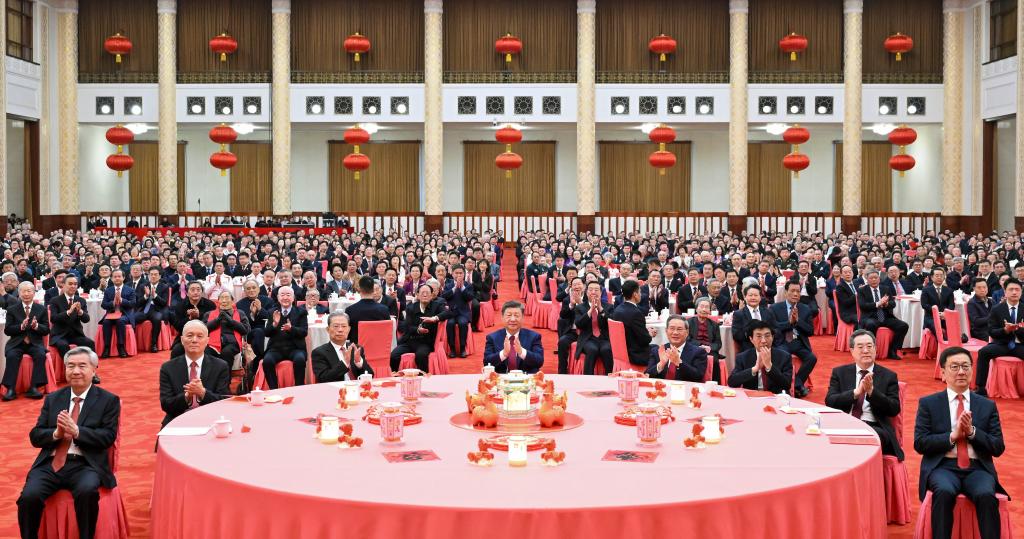
魏楚院长受邀参加中共中央国务院2026年春节团拜会
2026/02/15
-

双主校区迎佳节,师生共话贺新春——H comic 、和平与发展学院召开寒假留校学生座谈会
2026/02/10
-
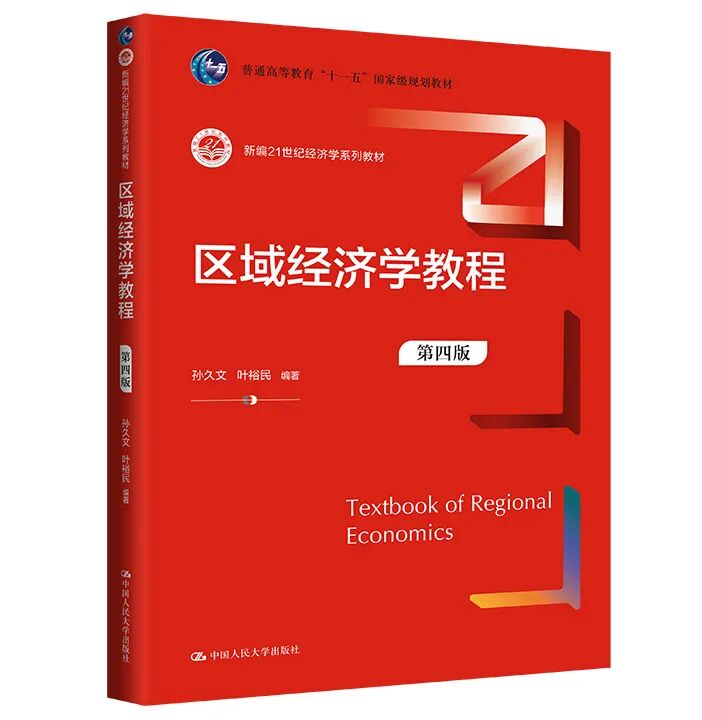
H comic 《区域经济学教程》教材入选“十四五”普通高等教育本科国家级规划教材名单
2026/02/06