




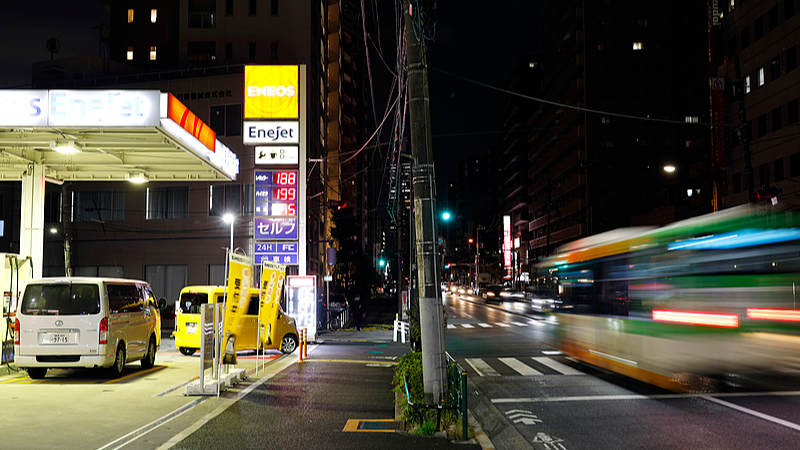
Vehicles refuel at a gas station in Tokyo, Japan, 18 March, 2026. Japan's Ministry of Economy, Trade and Industry confirmed that the nationwide average retail price for regular gasoline has reached a new record high, driven by a spike in crude oil prices fueled by escalating conflict in the Middle East. /VCG
Editor's note: Li Haoran is an assistant professor at the School of Applied Economics and the associate director of the Center for Research on Global Energy Strategy at Renmin University of China. Yang Yimin is an associate professor at the School of Finance at Renmin University of China. The article reflects the authors' opinions and not necessarily the views of CGTN.
As tensions in the Middle East intensify, the immediate concern is the security of global energy supply. For Japan, however, the danger goes beyond whether crude prices rise. The more consequential question is how an external energy shock interacts with a weakening yen, soft domestic demand and an already delicate policy transition. What may look like another round of geopolitical volatility is, for Japan, turning into a broader test of economic resilience.
The real danger is the overlap of two shocks: Higher oil prices and a weaker yen. For Japan, that combination is especially painful because it hits a long-standing weakness rather than a passing imbalance. The country remains heavily dependent on imported energy, especially crude oil from the Middle East. That means any disruption to shipping routes or supply flows quickly feeds into the domestic economy. If oil rises in dollar terms and the yen falls at the same time, the same barrel becomes more expensive twice. What could have stayed an energy-price shock then spreads much more widely, pushing up inflation while squeezing households, firms and the external balance.
That is what makes the current episode different from an ordinary commodity upswing. Yen weakness is not just happening alongside the oil shock; it is making the shock worse. As import costs rise, firms pay more for fuel, power, transport and a wide range of energy-intensive inputs. Many cannot pass those costs on fully without hurting demand. Households feel the same pressure through higher utility bills, fuel costs and everyday prices. Over time, that combination can weaken consumer spending and worsen the trade balance at once. If investors begin to doubt the government's broader policy mix, the currency can come under still more pressure, making the next round of imports costlier again. It becomes a vicious loop: Oil pushes up prices, yen weakness magnifies the damage, and the economy underneath grows weaker.
This is how stagflation risk creeps back in. Prices rise, but not because demand is strong or wages are driving a healthy expansion. They rise because an external supply shock is colliding with exchange-rate weakness. That is far harder to manage than demand-led inflation, because prices move up even as real incomes and growth come under pressure.
Against that backdrop, the Bank of Japan faces an increasingly awkward choice. Over the past year, it has been trying to step away from emergency-era easing without choking off the recovery. But not all inflation helps the BOJ in the same way. Inflation backed by stronger wages and firmer domestic demand gives the central bank more confidence that the economy can absorb tighter conditions. Inflation caused by higher import costs and a falling currency does not. It lifts headline prices, but says much less about the economy's underlying strength. An oil shock like this makes the BOJ's next move harder, not easier. Move too slowly, and yen weakness and imported inflation may intensify. Move too quickly, and the recovery could lose what little momentum it still has.
But the BOJ is not the only institution under pressure. The oil-yen shock is hitting Japan at a time when the government's fiscal credibility is also being tested. Since taking office, Prime Minister Sanae Takaichi has pushed a 21.3 trillion-yen stimulus package and proposed a temporary cut to the food consumption tax. The politics are obvious: When food and utility bills are rising, governments reach for subsidies and tax relief. But markets are less patient than voters. The question is not simply whether support is justified. It is whether the government can explain how it will pay for it, how long it will last and why temporary relief will not become another step toward looser fiscal discipline.
That matters because Japan no longer has much room to improvise. Extra subsidies or tax cuts may soften the immediate blow to households, and in the short run they may calm public anxiety. But if those measures are not tied to a credible medium-term fiscal plan, they are likely to deepen doubts about debt sustainability and future bond issuance. That could put further upward pressure on long-term yields. At that point, the authorities face an uncomfortable trade-off. If the BOJ lets yields rise, government financing costs go up and fiscal strains become harder to ignore. If it leans too heavily against higher yields through bond buying, then its commitment to normalization starts to look less convincing, and the yen may weaken again. Fiscal policy and monetary policy can no longer be discussed separately; the oil shock is now shaping both at the same time.
Japan is not doomed to crisis. There is a reasonable case for temporary relief when households are hit by a sudden jump in living costs, and temporary tax cuts are not the same as permanent fiscal loosening. It is also true that if nominal growth strengthens and holds up, tax revenues should improve over time. But all of that depends on credibility. If markets believe the support is limited, funded and reversible, the risks stay manageable. If they do not, then an oil shock can turn into something larger: A broader loss of confidence in the government's overall policy direction.
For that reason, this is a moment Tokyo cannot afford to misread. Japan is not dealing only with higher oil prices, or only with a weaker yen. It is dealing with the interaction of imported inflation, exchange-rate pressure, fiscal vulnerability and limited monetary room. Any one of those problems would be manageable by itself. Arriving together, they sharply narrow Japan's room to move. A de-escalation in the Middle East and lower oil prices would help. So would a clearer explanation from Tokyo of how its relief measures will be financed and when they will end. But unless those conditions improve, Japan risks slipping into a familiar pattern: Higher prices, weaker real incomes and shrinking policy flexibility. That is how stagflation risk returns — not as a sudden rupture, but as a gradual tightening of constraints on growth, stability and policy credibility.
作者:
李浩然 H comic
杨益民 H comic 财政金融学院
来源:CGTN
设计 责编:马文林
审核:李浩然 宋枫
相关新闻
-

《中东地缘冲突、能源安全与绿色转型》专题报告发布
2026/03/23
-
H comic 党委和中国农业发展银行国际部党支部联学共建
2026/03/20
-

H comic 文化产业团队赴紫光VID网络视听产业园调研
2026/03/20
-

H comic 、和平与发展学院召开新学期教职工大会 部署开展树立和践行正确政绩观学习教育
2026/03/14